Landmark
Port of Kismayo
A deep-water port built on a former island and linked to the mainland by a causeway, busy with cargo ships and fishing boats.

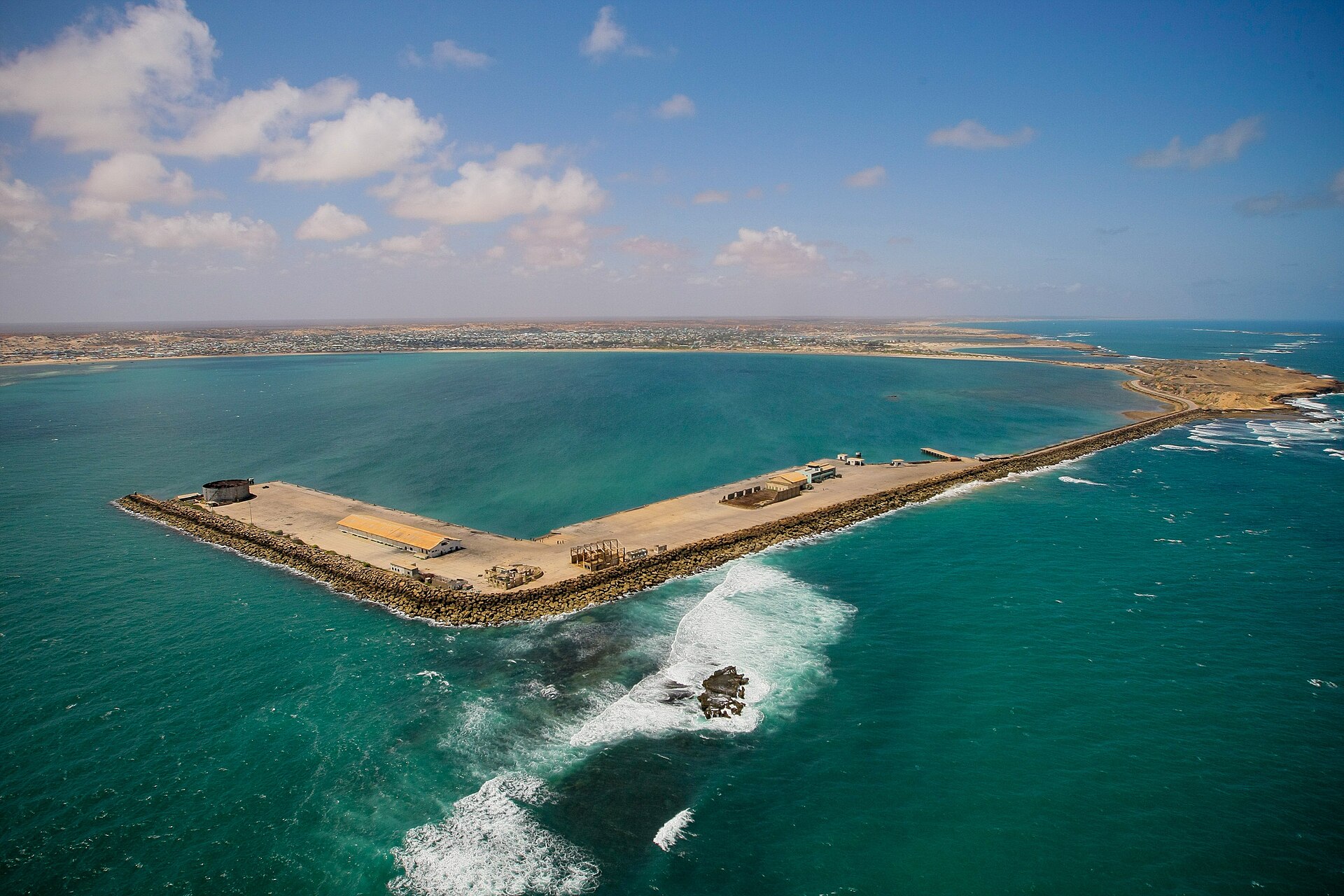
Jubaland's coastal capital near the mouth of the Juba River: a historic port city of sea breezes and sandy shoreline, with the Bajuni Islands strung along the coast to the south.
Kismayo sits on Somalia's southern Indian Ocean coast, close to where the Juba River meets the sea and roughly 500 km south-west of Mogadishu. It is the capital of the Lower Juba region and of Jubaland State, and UN-Habitat describes it as the commercial hub of southern Somalia.
The city grew up around one of the few sheltered anchorages between Mogadishu and Lamu. Its port stands on what was once one of the Bajuni Islands, joined to the mainland by a causeway, while sand dunes, rocky outcrops and sandy beaches line the shore on either side of town.
Today Kismayo is a busy, fast-growing city. New homes, hotels and shops have multiplied in recent years as traders, returnees and diaspora investors have settled here, and its airport and seaport connect the Juba valley with the wider region.
A deep-water port built on a former island and linked to the mainland by a causeway, busy with cargo ships and fishing boats.
About 15 km from the city the Juba cuts through red sand dunes to meet the Indian Ocean, near the village of Goobweyn.
A chain of small islands strung along the coast south of Kismayo, traditionally home to Bajuni fishing communities.
Sandy beaches and rocky outcrops line the shore around town, and beachfront hotels have opened in recent years.
Jubaland's largest stadium, rehabilitated and fitted with an artificial pitch.
The southern part of the city.
The north-eastern part of the city.
The north-western part of the city.
The northern part of the city.
The western part of the city.
This list contains verified names; editors keep adding more.
The Kismayo area began as a small fishing settlement and in the Middle Ages lay within the sphere of the Ajuran Sultanate. The town itself was founded in 1872 under the Sultan of Zanzibar and came under British control in 1887. In 1896 Britain made the land between the Juba and Tana rivers part of its East Africa territory, under the name Jubaland.
After the First World War Britain ceded the area to Italy, which called the town Chisimaio and formally annexed it to Italian Somaliland in 1926. After independence in 1960 the old port facilities were modernised and a large meat-processing plant was built, drawing workers from across the south.
The city went through many years of instability after 1991. Since 2013 it has been the seat of the Jubaland administration, and reconstruction and new investment have reshaped many of its neighbourhoods.
Kismayo is one of Somalia's most diverse cities. It is home to many Somali clans, to Somali Bantu (Jareer) communities and to the Bajuni, a coastal people with a long seafaring tradition who speak a dialect of Swahili. Mosques, Qur'anic schools and religious centres are found in every neighbourhood.
Football is a big part of city life. The rehabilitated Wamo Stadium, the largest in Jubaland, has an artificial pitch and hosts regional and national tournaments.
The seaport is the backbone of Kismayo's economy. Its two quays can take vessels of up to about 10,000 deadweight tonnes, making it one of Somalia's main ports after Berbera and Mogadishu. Historically the town was a major hub of the livestock trade.
Fishing, seasonal farming in the Juba valley and trade in imported goods support many households, while construction, retail, telecommunications, and hotels and restaurants have been among the fastest-growing sectors since investment returned.