Nature
The Juba river bend
The loop of the river around the town, most striking when seen from above.

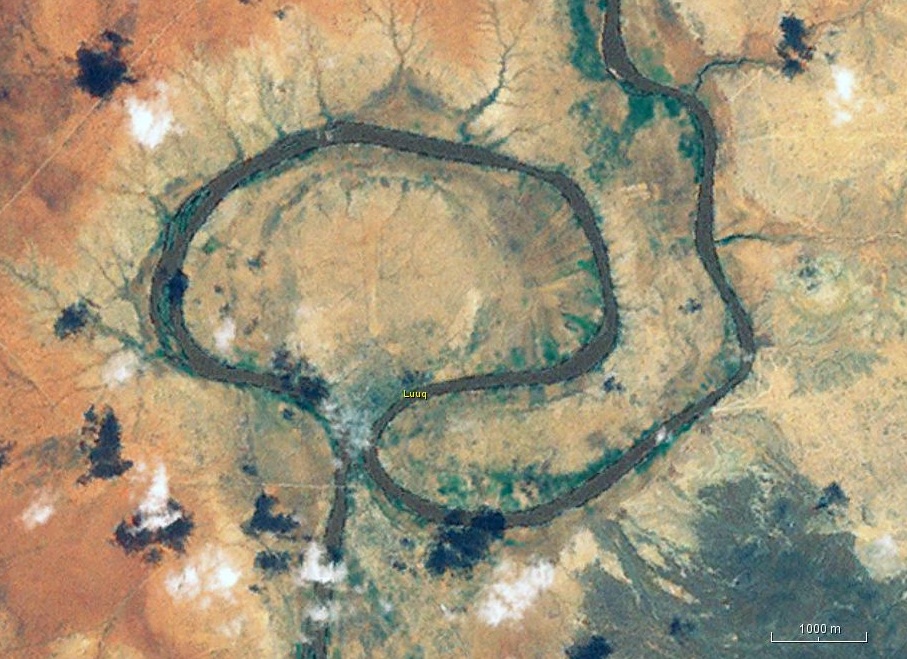
A historic Gedo trading town wrapped in a horseshoe bend of the Juba River, once a key inland market on caravan routes to Ethiopia.
Luuq sits inside a tight horseshoe bend of the Juba River (Ganaane), which almost encircles the town and leaves it on a near-island. It is the seat of Luuq District, about 70 km south-east of Doolow.
Its full name, Luuq Ganaane, comes from Ganaane, the Somali name for the Juba. UN-Habitat notes Luuq's sizeable farm production, and the town forms a three-district trading area with Doolow and Beled Xaawo.
The loop of the river around the town, most striking when seen from above.
Luuq and Baardheere were important inland markets on the Ganaane, linked to the Benadir coast and to caravan trade with Ethiopia. Doolow and Luuq lay on a trade route that ran from Baardheere through Luuq to Ginir in Ethiopia.
In 1895 the expedition of the Italian officer Vittorio Bottego founded an Italian station at Luuq, placed under Captain Ugo Ferrandi, and Italy later secured the town within Italian Somaliland. After independence in 1960 it became the centre of Luuq District.
Riverside farming is the mainstay, helped by the water that surrounds the land inside the bend. Trade with Doolow, Beled Xaawo and the Ethiopian border is also important. In the 19th century Luuq's market dealt in cloth, cattle and ivory.